
Most candidates completely miss the point of the “greatest strength” question. Learn how to answer it properly, avoid the common mistakes, and position yourself as the obvious hire.
More...
Along with its counterpart “what is your greatest weakness,” there is a very high probability that you will face this question at most interviews, and there is a good reason for this.
Asking you to pinpoint a single strength will give your interviewer vital information about whether or not you will be a good fit for both the role you are applying for and the organisation you are hoping to join.
Key Takeaways
On the surface, this question feels like a gift. You are being asked to talk about something positive, something you are good at, something that should put you in a strong position.
And yet, this is where a lot of good candidates quietly fall apart.
They talk too much, they say too little, they go generic and then go off track. Or they give an answer that might be true but completely misses the point of the job they are sitting in front of.
This isn’t a throwaway question. It is one of the clearest opportunities you get in an interview to demonstrate value.
Handled properly, it positions you as the obvious hire.
Handled poorly, it confirms every doubt the interviewer had.
Why Interviewers Actually Ask This Question
Interviewers are not asking because they are interested in your self-esteem or your ability to reflect.
They are asking because they are trying to make a decision.
Can you do the job, and will you do it well?
That is the entire point of the question whether they dress it up nicely or not.
Strip away the polite tone, the interview smiles and the small talk, and that is what they are trying to work out in a very short space of time. Not whether you are likeable, not whether you interview well, but whether you can actually step into the role and deliver something that makes a difference.
When you answer, you are not just giving them a strength. You are showing them how you think about your own capability. You are showing them whether you understand what the role genuinely requires, not what you hope it requires, and whether you can connect your experience to their needs in a way that is clear and believable.
A strong answer lands because it feels deliberate. It shows self-awareness without sounding rehearsed, relevance without forcing it, and credibility because it is backed up with something real. It tells the interviewer, quietly but clearly, this person gets it.
A weak answer does the opposite. It feels vague, disconnected or overly rehearsed without substance. It suggests a lack of preparation, a lack of focus, or worse, a lack of understanding of what the role actually involves. None of those are recoverable once the doubt is there.
And here is the part most people underestimate.
They are not just listening to what you say, they are watching how you say it.
They are judging whether you can structure a thought, whether you can communicate under pressure, whether you believe what you are saying, and whether you can make something complex sound simple. The content matters, but so does the delivery.
The structure, the clarity, the confidence, the relevance, all of it matters.
In that moment, you are not just answering a question. You are demonstrating how you will show up in the job.
The Mistakes That Will Cost You The Job
There are countless ways to get this wrong, but most candidates fall into a few predictable traps. If you have done a few interviews, you will recognise at least one. These are the behaviours that quietly cost people jobs.
Telling Your Life Story
Under pressure, people fill the silence. A simple answer turns into a running commentary of everything they have ever done well. More detail, more examples, and suddenly they are off track. The issue is not that it is wrong. It is that it is too much and not focused. Interviewers are not looking for your career highlight reel. They want one clear answer that shows why you will perform in their role.
Giving a generic answer
Team player, strong communicator and a hard worker. All could be true but all are totally forgettable without context.
If your answer could be dropped into another interview without anyone noticing, it is not doing its job. It does not differentiate you and it does not help someone make a decision.
Being too humble
They downplay achievements, soften their language and rush through examples as if they are trying not to stand out. It might feel comfortable, but it does you no favours. If you do not clearly show your value, the moment passes and the interviewer moves on. The skill is sitting between confidence and arrogance, where you can talk about what you have done in a grounded, credible way.
Zero preparation
This is the most frustrating because it is totally avoidable.
The question is predictable, yet people still try to wing it. They assume they can talk about their strengths naturally, but without preparation the answer is unfocused, inconsistent and forgettable. Preparation gives structure, credibility and confidence. Without it, you are relying on instinct, and instinct under pressure is rarely as sharp as people think.
Avoiding the question Altogether
“Others would say…”
“I’m not really sure…”
It might sound modest. It does not land that way. It sounds evasive or unprepared. Interviewers are looking for clarity and confidence. Step away from the question and you introduce doubt, and doubt is not something you can afford when decisions are being made quickly.
What a Strong Answer Actually Looks Like
A good answer isn’t complicated, but it is deliberate and thought through.
It has three clear components, and if you get all three right, your answer will land with impact and clarity.
First, you clearly state your strength. Not vaguely, not wrapped in filler, but in a way that is easy to understand and directly relevant to the role you are applying for.
Second, you provide proof. This is where credibility is built and where most candidates either stand out or fall away. You explain where you have used this strength, what you actually did, and what the outcome was, ideally with something measurable behind it.
Third, and most importantly, you link it back to the role in front of you. You make it clear why this strength matters in this context and how it will benefit the organisation, not just your career.
Without that final link, even a strong example can feel disconnected and, in some cases, wasted.The Simple Formula That Works
If you want something practical to work with, use this structure:
“My greatest strength is X. In my previous role, I used this to achieve Y, which resulted in Z. That is why I believe it will add value in this role.”
It is simple, but that is exactly why it works. It forces you to stay relevant to the role, structured in your delivery, and focused on outcomes rather than opinions. It also removes the temptation to ramble or drift into areas that do not add value, keeping your answer tight, credible and easy for the interviewer to follow.
How to Prepare Without Overcomplicating It
Preparation doesn’t need to be complicated. It does need to be deliberate.
The “what is your greatest weakness” question gets all the attention because people panic about saying something negative. In reality, most candidates get the strength question wrong long before they get to that point.
They either ramble, go generic, or talk about something that has absolutely nothing to do with the job.
Start with what you are good at. Not what sounds impressive, not what you think they want to hear, but where you consistently deliver, where you add value, and where people rely on you to get things done.
Then look properly at the job. Not the title, not the company name, but the actual requirements. What are they asking for? What problems are they trying to solve? Where are they likely to struggle if they hire the wrong person?
Now connect the two.
Your strength isn’t a personality trait you pick out of thin air. It is a commercial answer. It should clearly show how what you do well helps them solve their problem.
This is where most people fall over.
They know what they are good at, but they never link it to the role. So instead of sounding relevant, they sound rehearsed, too generic and easy to forget.
Breakdown Of A Strong Answer
A weak answer sounds like this:
“I am a strong communicator and a team player.”
There is nothing wrong with it, but there is nothing memorable about it either.
But imagine this was the job description you saw when applying
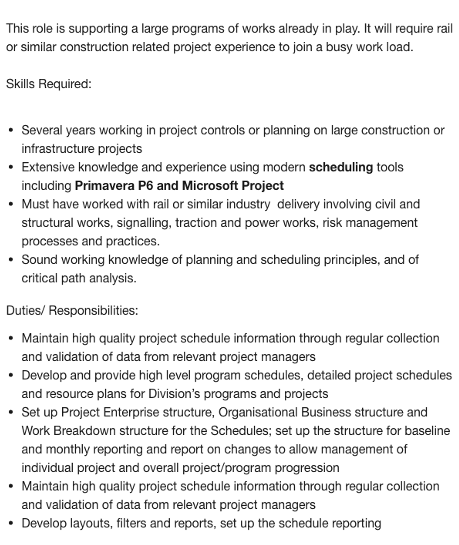
A stronger answer for this role could sounds like this:
“My greatest strength is delivering projects under pressure. On my last project, we were behind schedule due to supplier delays. I restructured the programme using Primavera P6, re-sequenced key activities and worked directly with contractors to recover time. We delivered two weeks ahead of the revised schedule and improved margin by 12%. That is why this role stood out to me, because it requires exactly that level of control and recovery.”
Now you are not just describing a strength. You are demonstrating value.
Some other good answers to the greatest strength question
Internal/External Liaison
“My strength is managing complex stakeholder environments, particularly during incident investigations. I have led ICAM root cause analysis processes involving clients, EPCM contractors and subcontractors, where opinions are often strong and timelines are tight. I focus on maintaining process and structure, ensuring the investigation reaches a proper conclusion and that real controls are implemented. That is directly relevant to this role, where those same challenges will exist.”
Time Management
“One of my key strengths is time management and delivery under pressure. When I commit to a deadline, I make sure it is met. Recently, we received critical data late from site, but I worked through the night to ensure the report was delivered on time. That report supported a successful presentation and ultimately helped secure a $2 million contract. That is the level of ownership I would bring to this role.”
Strength & Weakness
“My greatest strength actually came from what used to be a weakness. When I first worked FIFO, I struggled to balance work and home life. I addressed that by investing in personal development and building better structure and discipline. Since then, I have achieved three promotions, and I am now someone others come to for advice. I would bring that same leadership and resilience into this role.”
Each answer is clear, relevant and backed by evidence. They do not just state a strength; they prove it and then connect it directly to the job. That is what most candidates fail to do, and that is exactly where you can stand out".
FAQ
What is the best strength to give in an interview?
The one that directly aligns with the job requirements and can be backed up with real, credible examples. Not the one you like most, the one that matters most to the employer.
How many strengths answers should I prepare?
At least two or three. Questions are rarely asked in a neat, predictable way, and being able to adapt your answer is important.
Should I focus on technical or soft skills?
Focus on whatever drives performance in the role. In many cases, a combination works best, but relevance should always guide your choice.
What should I avoid saying?
Avoid generic statements, unproven claims and anything that sounds rehearsed without substance. If it cannot be backed up, leave it out.
Do I need to use the STAR method?
You don't need to reference it directly, but you do need to cover the situation, the action and the result. Without that structure, your answer lacks clarity and impact. Here's more information about the STAR Method.
Final Thought
Most people treat this question like a formality.
It is not.
It is one of the very few moments in an interview where you are given direct permission to explain, clearly and without interruption, exactly why you should be hired over the other people in the process.
If you get it right, it moves you forward and makes the decision easier for them.
If you get it wrong, it introduces doubt, and once doubt is there, it is very hard to recover from it.
The reality is, most people walk out of interviews thinking they did alright, never quite realising that this was the moment that decided it.
Unfortunately, most people never realise which one it was.
